Pharmaceutical
Compounding
Pharmaceutical compounding: what the standards require and why
Pharmaceutical compounding is the preparation of a medication tailored to a specific patient or a specific clinical need, from reconstituting an antibiotic in an IV bag to preparing a chemotherapy dose. The standards governing it changed materially on November 1, 2023, and state boards of pharmacy are still working through adoption on their own schedules.
This page covers what the current USP chapters require, what changed in the 2023 revision, how engineering controls fit into a compliant workflow, and why cleaning protocols have become the most common source of equipment problems in compounding pharmacies.
Baker has built engineering controls for sterile compounding for more than 70 years. Where this page makes a claim about airflow, materials, or disinfectant compatibility, it comes from published standards or from Baker’s own testing, and the source is named.
Which USP chapter applies to your work
The United States Pharmacopeia publishes the compendial standards for compounding. Chapters numbered below 1000 are enforceable. State boards of pharmacy are the primary enforcement body, and FDA, The Joint Commission, and state departments of health all reference them.
USP <800> has a particular history worth knowing. It was published in 2016 and became official in December 2019, but it stayed informational while <795> and <797> were under appeal. When the revised <795> and <797> became official on November 1, 2023, <800> became compendially applicable alongside them.
| Chapter | Scope |
| USP <795> | Non-sterile compounding. Creams, ointments, capsules, oral liquids. |
| USP <797> | Sterile compounding. Any preparation intended to be sterile, including IV admixtures, injections, and ophthalmics. |
| USP <800> | Hazardous drugs. Applies across receiving, storage, compounding, administration, and disposal, sterile or not. |
| USP <825> | Radiopharmaceuticals in nuclear pharmacy. Official December 2020. |
| USP <71> | Sterility testing. Referenced by <797> for extended beyond-use dating. |
Chapters overlap rather than replace each other. Sterile compounding of a hazardous drug is governed by <797> and <800> at the same time.
What the 2023 revision changed
The revision changed daily practice more than it changed equipment specifications. Four shifts matter most.
Risk levels are gone. Low, medium, and high risk were replaced by CSP Category 1, 2, and 3, which are defined by the conditions the preparation is made under and the beyond-use date being claimed.
Beyond-use dates tie directly to category, storage condition, and whether sterility testing was performed. The tables in the chapter are specific, and BUDs cannot be extended on the basis of professional judgment alone.
Monitoring frequencies are written out rather than described as periodic. Air sampling, surface sampling, and particle counting all have stated intervals.
Cleaning and disinfection expectations became explicit, including the requirement for a sporicidal agent on a defined schedule. This is the change that has had the largest unintended effect on equipment, covered further down this page.
The three CSP categories
Category 1: shortest beyond-use dates, 12 hours at controlled room temperature and 24 hours refrigerated. Can be prepared in a segregated compounding area rather than a full cleanroom suite.
Category 2: prepared in a classified cleanroom suite. Longer BUDs, which extend further when sterility testing is performed under USP <71>.
Category 3: the longest BUDs in the chapter, up to 90 days at room temperature, 120 days refrigerated, and 180 days frozen. Requires sterile gloves and gowns, more frequent personnel competency testing, additional environmental monitoring, and stability data. Category 3 requirements must be in place at least 30 days before Category 3 compounding begins.
What that means in practice
Most hospital pharmacies operate in Category 1 and Category 2. Category 3 is a deliberate program decision rather than something a pharmacy drifts into, and the 30-day lead time is frequently underestimated.
The category is determined by the conditions and the BUD claimed, not by the drug. The same preparation can be Category 1 or Category 2 depending on where it was made and how long it needs to last.
A shorter BUD is often the simpler answer. Pharmacies that push for extended dating take on sterility testing, additional monitoring, and documentation that has to hold up under inspection.
Primary engineering controls and how they differ
A primary engineering control, or PEC, is the device that provides the ISO Class 5 environment where the preparation is actually made. It sits inside a secondary engineering control, which is the classified room around it.
Choosing between PEC types comes down to one question: what needs protecting. Product only, or product and personnel and the environment.
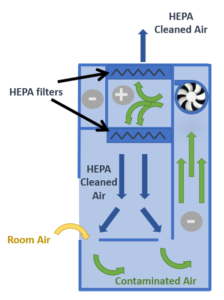
The term worth knowing is first air. It describes HEPA-filtered air that has not yet passed over anything. Air that has crossed an object is no longer first air, which is why anything placed between the filter and a critical site creates risk, and why equipment mounted inside the work zone matters more than it looks like it should.
Where each control fits
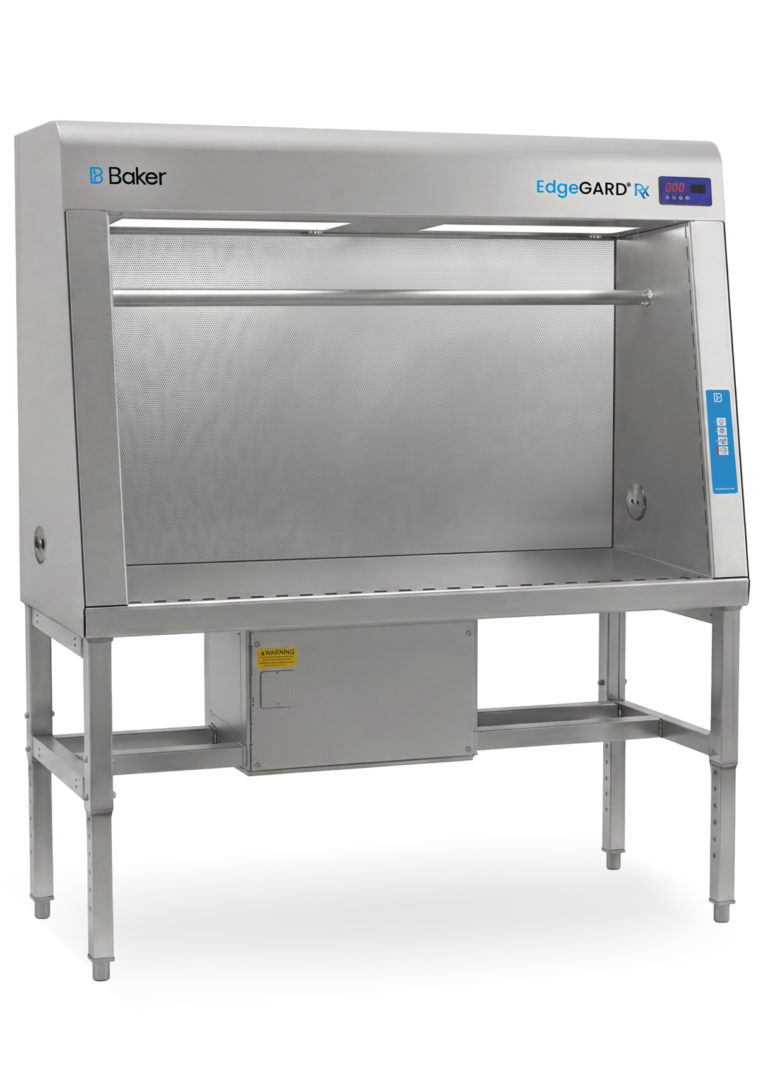
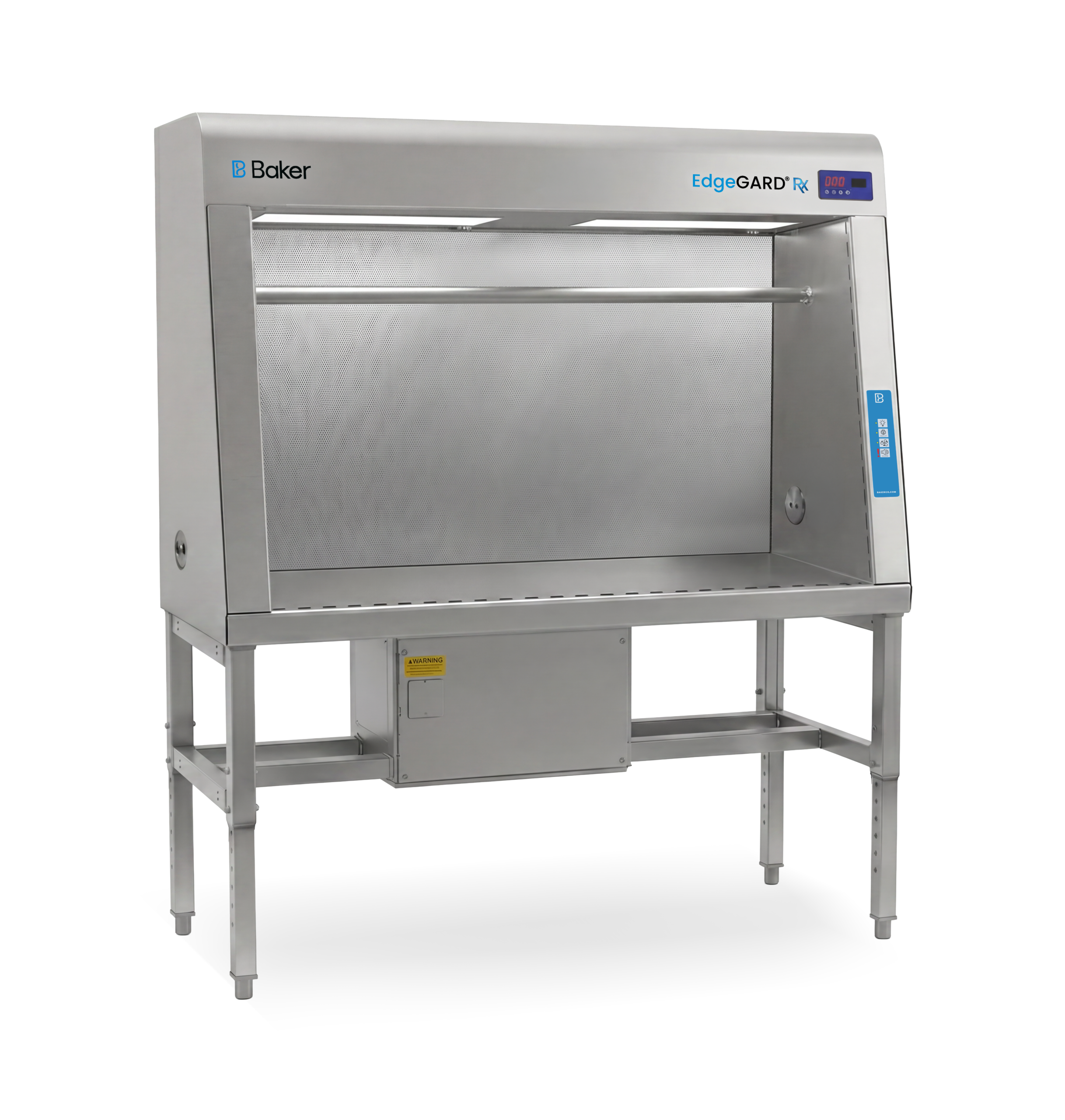
Horizontal laminar flow clean bench: HEPA-filtered air moves from the back of the cabinet toward the operator. Protects the product only. Appropriate for non-hazardous sterile compounding, and not appropriate for anything hazardous, since the airflow moves toward the person.
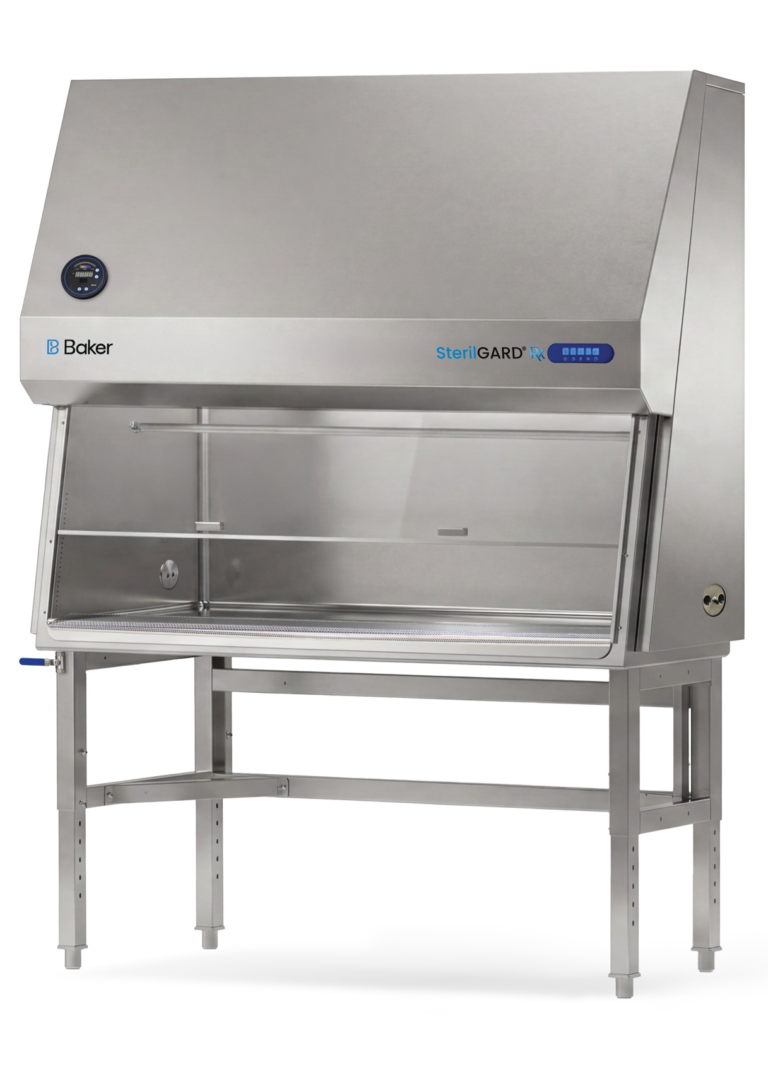
Class II Type A2 biosafety cabinet: provides personnel, product, and environmental protection. Minimum 100 fpm inflow at the sash opening, downward HEPA-filtered air over the work zone, and partial recirculation. The standard control for hazardous drug compounding.
Class II Type B2: total exhaust, hard-ducted, no recirculation. Used where volatile chemicals are involved beyond what a Type A2 is intended for.
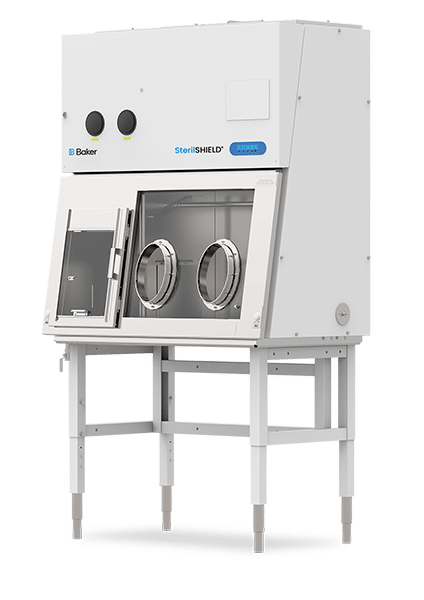
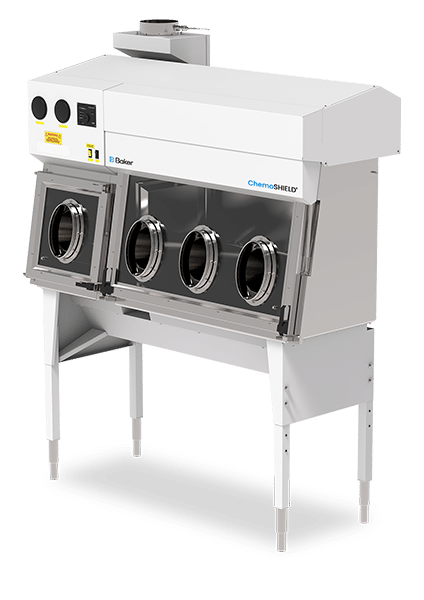
Compounding aseptic containment isolator: a leak-tight enclosure worked through glove ports, maintained at negative pressure.
The room around it
A Category 2 or Category 3 cleanroom suite is an ISO Class 7 buffer room with an anteroom, minimum 30 air changes per hour.
Buffer rooms for non-hazardous compounding are held at positive pressure relative to adjacent spaces. Rooms used for hazardous drug compounding are held negative, between 0.01 and 0.03 inches water column, so that contaminated air does not migrate out.
Certification matters as much as specification. USP <797> requires certification of primary and secondary engineering controls at least every six months, and whenever a unit is moved or the room is altered. Class II biosafety cabinets are certified to NSF/ANSI Standard 49.
Segregated compounding areas for Category 1 work are unclassified rooms containing a PEC. Simpler to run, and the tradeoff is the 12 hour BUD.
Cleaning protocols, and why compounding cabinets are starting to rust
Sterile 70% isopropyl alcohol is the everyday disinfectant in most compounding areas, and it is not sporicidal. USP <797> requires a sporicidal agent on ISO Class 5 and ISO Class 7 surfaces at least monthly, and Category 3 programs commonly run it more often.
Hazardous drug work adds steps. USP <800> describes a four-part sequence, and each part is a different chemistry doing a different job.
Deactivation renders the drug residue inert, typically with an oxidizer such as sodium hypochlorite or hydrogen peroxide. Decontamination removes the deactivated residue. Cleaning removes organic and inorganic material with a germicidal detergent. Disinfection destroys microorganisms, usually with sterile 70% IPA or an EPA-registered disinfectant.
Four chemical applications on the same stainless surfaces, on a defined schedule, indefinitely.
The chemistries that do sporicidal and deactivation work are chlorine, peracetic acid, and hydrogen peroxide based. They are effective, and they are hard on steel. Pharmacies that adopted a monthly sporicidal protocol after the 2023 revision are now finding corrosion at hinges, screw heads, seams, perforated diffusers, outlet covers, and cable ports. Painted surfaces blister and chip first, and once the coating is broken the substrate goes quickly. Rust inside an ISO Class 5 environment is a cleanability problem before it is anything else.
Baker tested common disinfecting agents against both grades of stainless steel used in compounding equipment.
Ratings from the Cole Parmer material compatibility database.
| Agent | 304 stainless | 316 stainless |
| Sterile water | A | A |
| Ethanol | A | A |
| Isopropyl alcohol, 70% | B | B |
| Peridox | B | B |
| Sodium hypochlorite, under 20% | C | C |
| Sodium hypochlorite, 100% | D | D |
| Vesphene Environ | D | B |
| LpH III se | D | B |
| EcoLab disinfectant cleaner | C | B |
| Iodine | D | D |
A: excellent. B: minor effect, slight corrosion or discoloration.
C: moderate effect, not recommended for continuous use. D: severe effect, not
recommended for any use. Anything rated B or lower needs a sterile water or
ethanol rinse to remove chemical residue.
304 and 316 stainless steel
304 stainless is roughly 18% chromium and 8% nickel. 316 adds about 2% molybdenum and carries roughly 16% chromium and 10% nickel. The molybdenum is what resists chloride corrosion, and it is the reason agents that rate D against 304 rate B against 316.
316 is not immune. Bleach at working strength still rates C against both grades. What 316 provides is margin, which is what a pharmacy running a monthly or weekly sporicidal protocol needs.
Three practices reduce corrosion regardless of grade. Rinse after any agent rated B or lower, since residue left to sit is what does the damage. Check contact time and dilution against the manufacturer’s instructions rather than using a stronger solution for longer. Remove components that penetrate the interior steel if the workflow does not require them, because plumbing fittings, interior outlets, and cable ports are where corrosion starts.
Hazardous drug compounding under USP <800>
A hazardous drug is one that appears on the NIOSH list of antineoplastic and other hazardous drugs in healthcare settings. The list continues to expand, including into newer categories such as antibody-drug conjugates, so an entity’s hazardous drug list is a document that gets revisited rather than written once.
USP <800> applies across the whole continuum. Receiving, storage, compounding, administration, and disposal, sterile and non-sterile alike. Small exposures matter here, because the risks include reproductive harm at doses far below anything therapeutic.
Every entity handling hazardous drugs needs a designated person responsible for the program, a written hazardous drug list, and documented containment, spill, and disposal procedures. Pharmaceutical compounding of hazardous drugs is governed by USP <797> and USP <800> simultaneously.
Containment requirements
Sterile hazardous compounding is performed in a containment primary engineering control, which means a Class II biosafety cabinet or a compounding aseptic containment isolator.
The control is externally vented and sits in an ISO Class 7 containment secondary engineering control held at negative pressure, between 0.01 and 0.03 inches water column.
Closed system drug-transfer devices are required during administration of antineoplastic hazardous drugs and should be used during compounding when the dosage form allows.
Personal protective equipment follows the chapter and the drug’s own documentation, including chemotherapy-rated gloves changed on a defined interval.
Assessment of risk
USP <800> allows an entity to perform an assessment of risk for certain hazardous drugs and adopt alternative containment strategies rather than applying the full requirements.
The assessment applies to final dosage forms of certain drugs, for example counting intact tablets. It does not apply to antineoplastic hazardous drugs requiring manipulation beyond what the packaging provides.
An assessment of risk is a documented decision, reviewed at least every 12 months. Inspectors ask to see it, and an undocumented assumption that a drug is low risk is a common finding.
Environmental monitoring and what inspectors actually cite
The most common inspection findings in compounding pharmacies are not equipment failures. They are monitoring gaps, incomplete records, and aseptic technique observed during the inspection itself. USP <797> requires that documentation be readily retrievable, and a program that is compliant in practice but cannot produce records on request will be cited as though it is not.
Required frequencies
Viable air sampling: at least every six months for Category 1 and Category 2, monthly for Category 3.
Surface sampling: monthly for Category 1 and Category 2, weekly for Category 3.
Nonviable airborne particle counting: at least every six months, performed under dynamic operating conditions.
Certification of engineering controls: at least every six months, and after any relocation or room alteration.
Personnel competency, including gloved fingertip and media fill testing, on the interval stated for the category.
When a result exceeds an action level
Identify the organism to the genus level. Species identification is recommended when the organism is of a type that suggests a specific source.
Investigate for a root cause rather than re-sampling until a clean result appears.
Document the investigation, the corrective action, and the verification that it worked.
Keep the records retrievable. Pressure differential logs, certification reports, cleaning logs, training records, and monitoring results should be produceable during an inspection rather than after it.
Common questions about pharmaceutical compounding
Does USP <797> require a sporicidal agent?
Yes. A sporicidal agent is required on ISO Class 5 and ISO Class 7 surfaces at least monthly. Sterile 70% IPA is not sporicidal and does not satisfy this requirement on its own.
Can I use bleach in a biosafety cabinet?
It can be used and it is commonly required for hazardous drug deactivation, with two conditions. Sodium hypochlorite is corrosive to both 304 and 316 stainless, and it must be followed by a sterile water or ethanol rinse to remove residue. Leaving it to dry on the surface is what causes pitting.
Is UV light an effective disinfectant in a BSC?
Only under conditions most pharmacies cannot maintain. Baker’s testing found a clean new bulb well above the minimum intensity took about 12 minutes to kill half the bacteria on a plate and required a full 24 hours for complete kill, with effectiveness dropping as distance from the bulb increased. Both the BMBL and NSF/ANSI Standard 49 state that UV is not recommended in biosafety cabinets. Where it is used, it should be a secondary method alongside a chemical disinfectant.
What is the difference between a clean bench and a biosafety cabinet for IV prep?
A horizontal flow clean bench protects the product only, with air moving from the back of the cabinet toward the operator. A Class II biosafety cabinet protects the product, the operator, and the environment. For non-hazardous sterile compounding, either can provide the ISO Class 5 environment. For anything hazardous, a clean bench is not an acceptable control.
How often does a compounding cabinet need to be certified?
At least every six months under USP <797>, and again whenever the unit is moved or the surrounding room is altered. Class II biosafety cabinets are certified to NSF/ANSI Standard 49.
Do the USP chapters apply in my state yet?
The chapters became official on November 1, 2023, and state boards of pharmacy adopt and enforce them on their own timelines. Check your state board directly rather than assuming a national effective date.