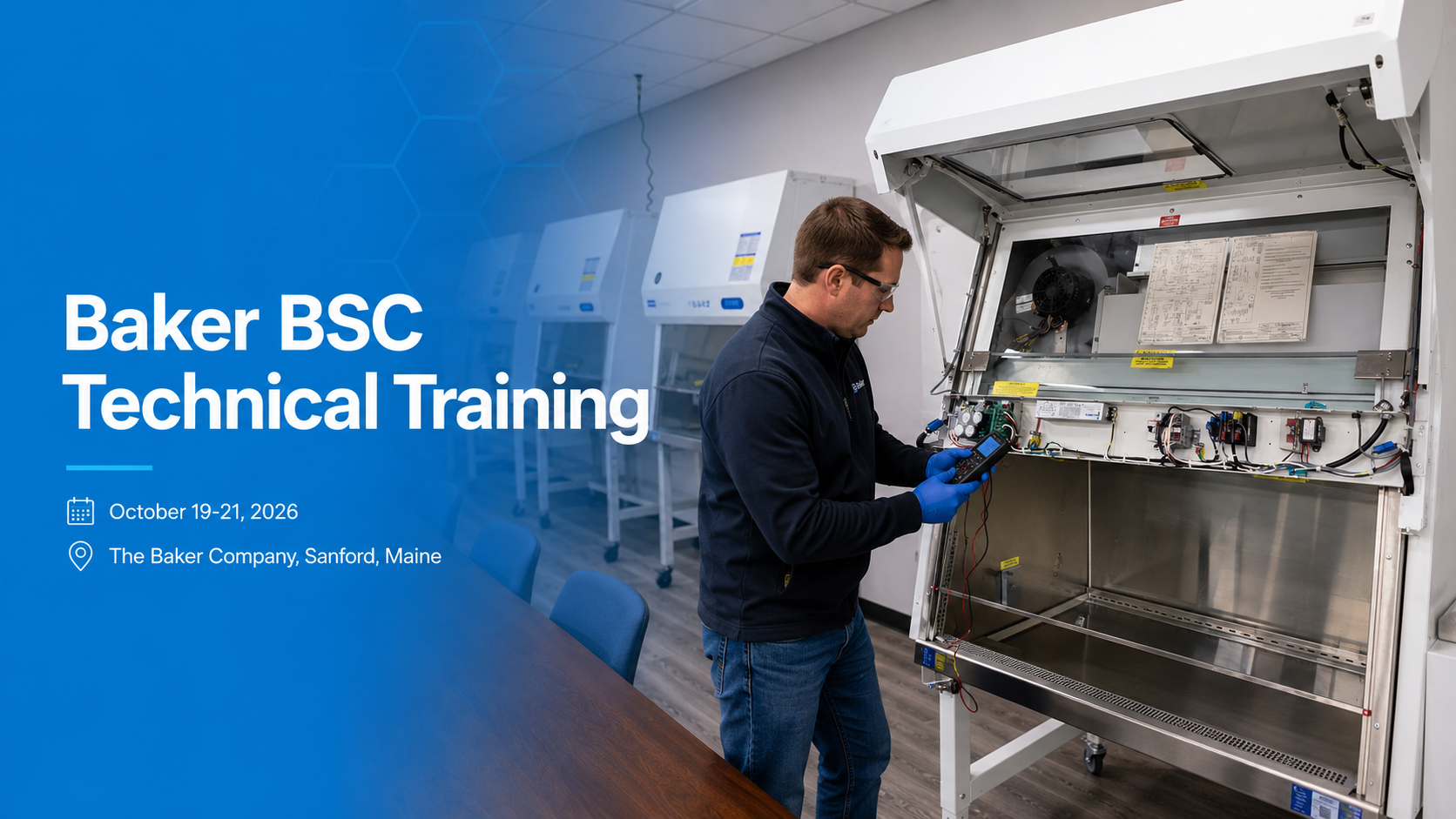
Biosafety Cabinet Certification
Field certification of a biosafety cabinet is essential to verify that the cabinet continues to provide the product, personnel, and environmental protection that it was designed to offer
Requirements for Class II biosafety cabinets in the United States are established by NSF International and published in NSF/ANSI Standard 49. NSF 49 includes definitions of the types and function, acceptable materials, design and construction requirements, and performance requirements for Class II biological safety cabinets. NSF International also manages a program of type testing and product certification for the cabinets. Specific requirements for field certification are included in Annex F of the standard. Additionally, to ensure that individuals performing certification are properly qualified, NSF International administers a program for Biosafety Cabinet Field Certifier Accreditation.
Field Tests for Biosafety Cabinets
Biosafety cabinet field tests should be performed by the certifier upon installation and relocation of cabinets, after major maintenance or changing of HEPA filters is conducted, and at regular intervals thereafter. NSF 49 recommends no more than 12 months between certification, though many organizations recertify more frequently. For example, pharmacies certify their biosafety cabinets every 6 months as required by USP Chapter <797> on sterile compounding.
In order to verify proper operation of a biological safety cabinet, the following tests are performed. These tests are related to the containment and product protection provided by the cabinet, and results must correlate to the value obtained by NSF for type testing of that particular make, model, and size of cabinet. These values should be provided by the cabinet’s manufacturer.
- Downflow velocity test
- Inflow velocity test
- Airflow smoke pattern tests
- HEPA filter leak test
- Cabinet integrity test (for Type A1 cabinets with positive-pressure contaminated plenums only)
- Alarm function verification
- Blower interlock (for Type B1 and B2 cabinets)
- Exhaust system performance (for any cabinet connected to the building exhaust system)
Optional Validation Tests for Biosafety Cabinets
While not part of Class II biosafety cabinet certification to NSF Standard 49, for certain installations additional validation tests may be required. For example, most cGMP compliant facilities will verify air cleanliness with a particle counter to the required ISO class per IEST protocols. Any such validation tests should be performed in conjunction with field certification.
The following tests, which are related to worker comfort and safety, may optionally be performed. These tests verify functions of the cabinet not directly related to containment or product protection.
- Lighting intensity test
- Vibration test
- Noise level test
- Electrical tests (leakage, ground circuit resistance, and polarity)
Accreditation for Biosafety Cabinet Field Certifiers
Because of the specialized knowledge required for proper and safe certification of biosafety cabinets, NSF International administers an accreditation program for field certifiers. To become accredited, a field certifier must pass a written and practical test administered by NSF. Additionally, continuing education and periodic reexamination are required in order to maintain accreditation.
When selecting a service provider for certification, biosafety cabinet owners should be sure that the vendor company’s technicians are accredited field certifiers. To help locate a certifier, NSF maintains a searchable listing of accredited certifiers. Certification companies also provide service when problems with biosafety cabinet function occur between regular certification intervals, or when maintenance tasks such as filter changes are necessary. If an organization performs certification using its own employees, such technicians should also obtain NSF accreditation to be sure that they possess the knowledge and experience required for field certification of biosafety cabinets.
Training for Biosafety Cabinet Certifiers
The Eagleson Institute is a non-profit foundation dedicated to promoting the principles and practices of laboratory safety through seminars, videotapes, interactive CD-ROMs, scholarships, lectures and a worldwide referral service. They offer a variety of courses carefully designed to allow participants to refine their technical skills while gaining confidence and an in-depth appreciation of airflow, chemical safety, and laboratory safety concepts. Since the institute’s founding in 1989 by The Baker Company, hundreds of people from around the world have attended their specialized courses to gain the skills to become accredited biosafety cabinet certifiers.
Learn more about Class II Biosafety Cabinets
Review the protection levels and key features of Class II Biosafety Cabinets in this free guide that includes an easy-to-read chart explaining how the types of Class II cabinets differ and graphics illustrating the supply, exhaust and recirculation airflow patterns that classify Type A1, A2, B1 and B2 cabinets.