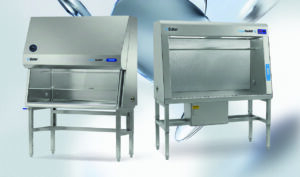
Why EdgeGARD® Has Return Air Slots: See What Baker’s Testing Shows

An empty horizontal laminar flow clean bench does its job well. HEPA-filtered air moves across the work surface toward the operator, and the work zone stays clean. Compounding never happens in an empty cabinet, though. Once a hand, a vial, an IV bag or a compounder enters the airstream, the airflow changes, and so does the protection it provides. That’s the problem EdgeGARD® return air slots were designed to solve.
The Wake Behind Every Object
Clean air has to flow around anything placed in its path. On the downstream side of that object, between the object and the operator, the air becomes turbulent and pressure drops. That low-pressure pocket can pull unfiltered room air back into the work zone. The risk is highest at the front of the cabinet, where clean air meets room air.
Clean benches are typically certified empty or “at rest,” so standard testing doesn’t capture this effect. The cabinet can pass certification and still let room air reach the critical site during actual work.
How the Return Air Slots Work
EdgeGARD® clean benches have high-velocity return air slots along the front edge of the work surface and the sidewalls of the access opening. Air is drawn into these slots at more than ten times the supply airflow velocity. In Baker‘s original testing, slot velocities measured 1,150 to 1,300 fpm against a supply airflow of about 100 fpm.
The slots pull disturbed air out of the boundary areas where turbulence forms, before it can roll back toward the work. They also capture room air at the opening before it reaches the work surface. This keeps the primary horizontal airflow moving in one direction, even with equipment and hands in the cabinet.
See the Difference
Both halves of this clip show the same EdgeGARD® clean bench running the same test. The operator holds a flask in the airstream while a smoke wand releases smoke directly behind it, where turbulence forms.
Top: Return Air Slots Taped Off
With the front slots sealed to simulate a conventional clean bench, nothing captures the disturbed air. The smoke spreads, swirls and pools across the work surface, which is the same path room air can take into the work zone.
Bottom: Return Air Slots Active
With the slots working, the smoke is pulled down into the slots at the front edge and cleared from the work area before it can drift back toward the work.
The Testing Behind the Design
Baker has tested the slots since they were introduced. In a comparative study published in the Baker Foundations series, researchers tested an EdgeGARD® against the same cabinet with its slots sealed to replicate a common horizontal laminar flow hood. Ambient air in the room was estimated at more than 750,000 particles per cubic foot.
Particle counts (0.5 µm and larger, per cubic foot), measured 3 inches and 6 inches in from the front of the work surface:
| Condition | EdgeGARD® at 3 in | EdgeGARD® at 6 in | Sealed slots at 3 in | Sealed slots at 6 in |
|---|---|---|---|---|
| Cabinet empty | 2 | 0 | 140 | 24 |
| Microscope in work area, at rest | 13 | 10 | 22,530 | 19,870 |
| Operator working at microscope | 44 | 23 | 190 | 544 |
With equipment in place, the sealed-slot bench exceeded Class 10,000 limits under Federal Standard 209. EdgeGARD stayed within Class 100 in every condition.
Recent testing on the EdgeGARD® HF confirmed the same performance under today’s standards. Baker challenged the cabinet with an ISO Class 8 background of at least 3,520,000 particles per cubic meter and sampled 18 locations across the work area at 80 and 100 fpm. The cabinet maintained ISO Class 5 or better at 6 inches and 14.5 inches from the supply diffuser and 2 inches outside the front opening. At 100 fpm, ISO Class 5 air was also measured 6 inches outside the front opening. Smoke testing with a mocked-up Baxter ExactaMix-2400 compounder in the work area showed turbulence around the equipment, as expected, with the horizontal airflow still clearing the work area at both settings.
Where to Work
The slots improve airflow control across the entire work surface, but aseptic technique still matters. For the full benefit of the slots and the cleanest location for critical operations, work at least 6 inches back from the front of the work surface.
Built Into Every EdgeGARD® Since 1962
Baker originated high-velocity return air slots in 1962, and they remain a core part of the EdgeGARD® design today, including EdgeGARD® e3 HF and the pharmacy-optimized EdgeGARD® Rx. When clean air meets real work, the slots help keep room air out of the critical area.