Increasing Cell Adherence with a Hypoxia Workstation
By Samir Patel, Garry Taylor, M.Sc., Rachel Steeg, Ph.D., and Kara Held, Ph.D.
Abstract
A common concern with all-in-one workstations, also known as incubated workstations or incubated glove boxes, is that excessive vibration could negatively impact cell growth and adhesion. This study evaluated cell adhesion capabilities within a Baker Ruskinn SCI-tive hypoxia workstation compared to a standard CO₂ incubator. The study tested the impact of adding rubber feet (ferrules) to the workstation’s interior floor tray. Results demonstrated that using all 15 ferrules improved cell adhesion by 25% over the standard incubator. Vibration reduction was confirmed across all planar directions, highlighting that the ferrules significantly decrease vibration exposure and enhance cell adhesion, both critical factors for cell culture growth…
Introduction
Traditional cell culture methods rely on continuous incubation in a controlled warm environment, with CO₂ incubators being the most commonly used tool. However, workstations are gaining popularity due to their ability to maintain a constant environment, allowing for media changes and imaging without exposing cells to external air. This is particularly advantageous for hypoxic conditions, which have been shown to be beneficial for various cell types, including stem cells (Kay et al., 2015).
A primary concern with workstations is the potential vibration exposure from integral fans, which may affect cell adhesion. This study compares monolayer cell adhesion in a standard CO₂ incubator versus the Baker Ruskinn SCI-tive hypoxia workstation. The SCI-tive workstation offers continuous recirculation of user-defined O₂ and CO₂ levels, providing an environment that closely mimics in vivo conditions.
Materials and Equipment
| Materials | Catalogue # | Supplier |
| SCI-tive | RUS.SCI001N | Baker Ruskinn, Wales, UK |
| H9 human embryonic stem cells | HTB-176 | ATCC |
| Black 96-well cell culture dishes | 655090 | Greiner Bio-One |
| mTESR | 05850 | StemCell Technologies |
| Accutase | A1110501 | Life Technologies |
| Knockout-DMEM | 10829-018 | Life Technologies |
| Rho Kinase inhibitor Y27632 dihydrochloride | AB120129 | Abcam |
| Vybrant Cell Adhesion Assay | V13181 | Life Technologies |
| SpectraMax® M3 Multi-Mode Microplate Reader | M3 | Molecular Devices |
| Heraeus™ Multifuge™ X1 R Benchtop Centrifuge | 75004251 | Thermo Scientific |
Methods
Cells labeled with Calcein were plated to assess adherence relative to a standard incubator. The Vybrant Cell Adhesion Assay was used to measure cell adhesion, with Calcein fluorescence (excitation at 485 nm, emission at 520 nm) serving as the readout. H9 human embryonic stem cells were maintained in mTESR and dissociated using Accutase. Cells were washed and plated at 2.5 x 10⁵ cells per well in a 96-well plate. After a 60-minute incubation period, non-adherent cells were removed, and fluorescence was measured.
Experiments were conducted using:
- Standard CO₂ incubator
- SCI-tive hypoxia workstation floor tray
- SCI-tive workstation with an anti-vibration plate
Vibration measurements were taken using an Android Nexus 7 tablet and the Physics Toolbox app.
Results
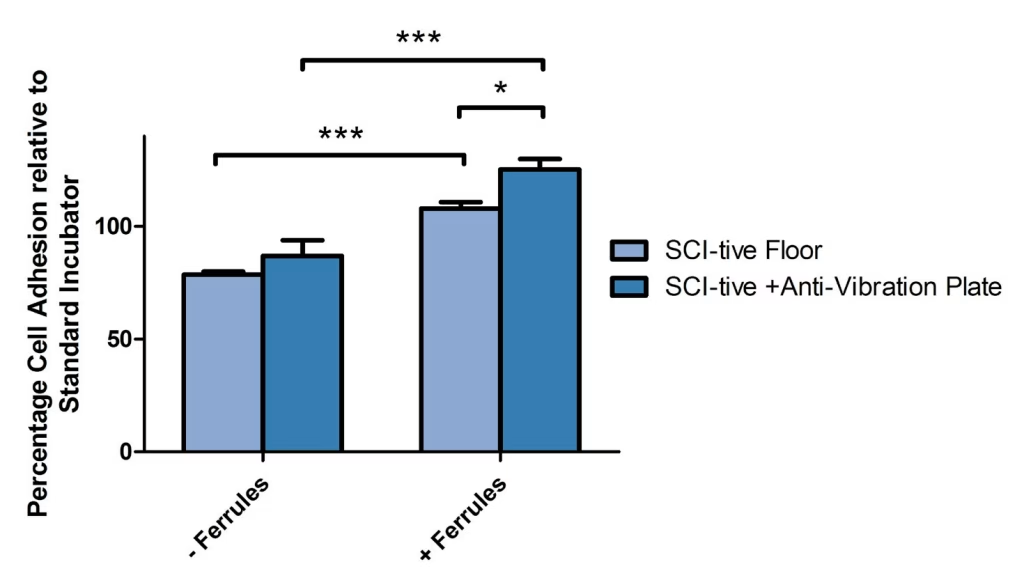
Initial serial dilution experiments confirmed that 2.5 x 10⁵ cells per well provided a strong signal for adhesion assays. Without ferrules, cell adhesion in SCI-tive was lower than in the standard incubator (78.6 ± 1.4%). However, the addition of ferrules significantly improved adhesion, surpassing the standard incubator at 107.9 ± 2.9% (p = 0.0008) and 125.27 ± 4.7% (p = 0.01) with the anti-vibration plate.
Adding weight (5 kg) to the workstation negated the positive effects of the ferrules. The vibration reduction results indicated a 59% reduction along the Y-axis and 30% along the Z-axis with the ferrules in place.
Conclusions
The addition of ferrules to the SCI-tive workstation significantly enhances cell adhesion, mitigating the adverse effects of vibration. This improvement positions the workstation as a viable alternative to standard incubators, especially for sensitive cell lines or limited samples. However, adding weight to the system counteracts these benefits. Proper workstation setup and awareness of internal vibration sources are crucial for optimizing cell culture conditions.
References
Kay, A. G., Dale, T. P., Akram, K. M., Mohan, P., Hampson, K., Maffulli, N., Spiteri, M. A., El Haj, A. J., Forsyth, N. R. (2015). BMP2 repression and optimized culture conditions promote human bone marrow-derived mesenchymal stem cell isolation. Regenerative Medicine, 10(2), 109–125.
For more information on the SCI-tive hypoxia workstation, visit https://bakerco.com/product/sci-tive/