2025 AO Orthopedic Research Summit: Why Low Oxygen Workstations Are Game-Changers for Regenerative Orthopedic Research
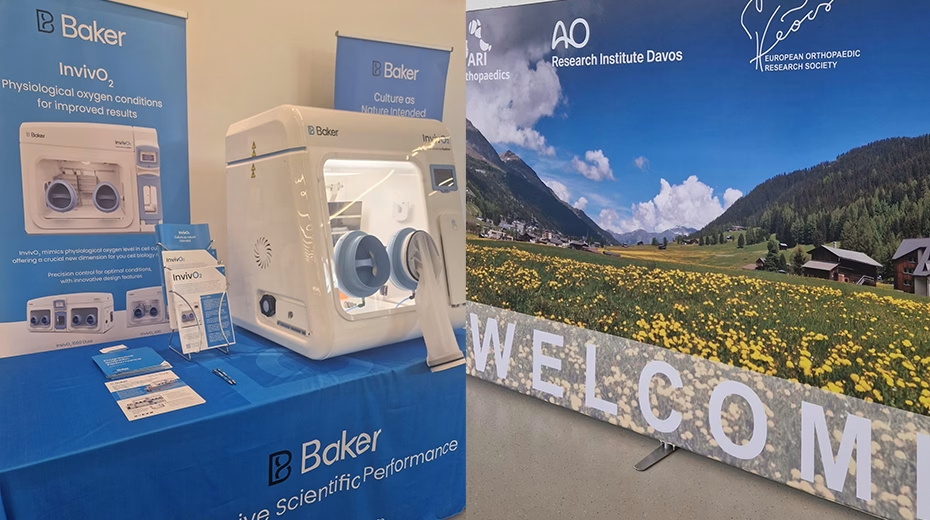
The 2025 AO Orthopedic Research Summit in Davos brought together leading voices in musculoskeletal science to discuss the future of regenerative orthopedic care. As a sponsor of the event, The Baker Company was on-site to engage with researchers focused on improving outcomes in tendon and bone repair. Among the most compelling discussions was the growing evidence that oxygen levels play a critical role in stem cell behavior, particularly in tendon-derived stem cells. This aligns closely with recent findings in regenerative medicine and highlights how low oxygen workstations can advance orthopedic research by replicating in vivo conditions more accurately than standard incubators.
Stem Cells Respond Differently to Oxygen Levels
A 2025 study by Citro et al. found key differences in how MSCs and TSCs behave in various oxygen environments. MSCs require external growth factors such as GDF-7 and tend to differentiate in standard oxygen conditions (21%). TSCs, on the other hand, naturally differentiate in 2% oxygen without any added growth factors. This low oxygen condition closely resembles the environment inside human tissues.
Why 2% Oxygen Is Important
Most body tissues operate at oxygen levels between 1% and 5%. Culturing cells in physoxia provides several advantages:
- More natural gene expression patterns (Scx, Tnmd, Thromb-4, Tnc-C)
- Faster and more efficient stem cell differentiation
- Elimination of expensive and unstable growth factors
- Increased consistency and reproducibility in research
Limitations of Standard Incubators
Standard incubators are not capable of maintaining a 2% oxygen environment. They also introduce variability during critical processes such as media preparation and cell handling. Low oxygen workstations address these issues by offering:
- Real-time, stable oxygen control
- Deoxygenated media preparation prior to cell exposure
- A consistent low oxygen environment throughout the entire workflow
Side-by-Side Comparison of Stem Cell Requirements
| Stem Cell Type | Oxygen Required | Growth Factor Needed |
| MSCs | 21% (Air) | Yes (GDF-5, GDF-6, GDF-7) |
| TSCs | 2% (Physoxia) | No |
This comparison highlights the importance of matching the culture environment to the biological needs of the cells. For TSCs, simply using a low oxygen setting is enough to promote tendon-like behavior.
Scientific and Business Advantages
| Feature | Benefit | Business Impact |
| 2% oxygen environment | Reflects in-vivo tissue conditions | Improves accuracy and translational relevance |
| TSCs differentiate naturally | No need for growth factors | Reduces spending on consumables |
| Improved gene expression | Reliable differentiation results | Strengthens research quality and publication outcomes |
| Controlled environment | Repeatable, high-quality workflows | Enhances lab credibility and operational efficiency |
Low oxygen workstations are no longer optional for serious research in tendon regeneration or orthopedic tissue repair. By replicating the internal conditions of the human body, these systems help researchers achieve cleaner results, reduce operating costs, and generate more impactful discoveries.