BSC Mythbusters: Volatile Chemicals and Class II Type A2 “Recirculated” BSCs – How Much is Safe?

In this post, we’ll explore the different types of biosafety cabinets and how they handle air and volatile chemicals. We’ll also look at how much chemical usage is considered safe within a biological safety cabinet (BSC), the distinctions between Type A2 “recirculated” BSC’s and Type B2 BSC’s, and the best practices for maintaining safety standards in laboratories.
Understanding Biosafety Cabinets
A biosafety cabinet is a ventilated enclosure designed for safely working with biohazards and aerosols. These microbiological safety cabinets are vital for protecting personnel, the environment, and the products being handled from these hazards. Their ability to create this protection is by filtering air through HEPA filters which capture particles. However, HEPA filters do not capture gases or vapors, which brings us to our hazard of focus: volatile chemicals.
Biosafety cabinets are grouped into three classes:
- Class I: Protects personnel and the environment.
- Class II: Provides protection for personnel, products, and the environment.
- Class III: Fully enclosed, gas-tight cabinets designed for the highest-risk agents.
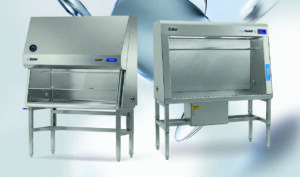
Among Class II cabinets, there are five types (A1, A2, B1, B2, and C1), each with varying air-handling capabilities. Our focus here is on Type A2 BSCs, which use a minimum intake airflow of 100 feet per minute through the front access opening and offers some recirculation of the airflow within the cabinet.
Handling Volatile Chemicals in A2 Biosafety Cabinets
When working with volatile chemicals in a biosafety cabinet, it’s crucial to understand how these chemicals interact with the HEPA filters. HEPA filters are highly effective at capturing particulates, but they do not filter out vapors or gases, meaning volatile chemicals can pass through, contaminating the surrounding air. This contamination could spread through your building and even outdoors, posing serious risks.
To minimize this, labs use a canopy or exhaust connection that vents the contaminated air outside, helping to dilute the chemicals. We often say, “The solution to pollution is dilution”—the more you can vent volatile chemicals outside, the safer the environment will be. Many labs use 100% exhausted cabinets, like the Type B2 BSC to accomplish this, with the fear that a recirculating cabinet would keep the hazard in the BSC leading to unsafe levels.
Key Safety Considerations
When using volatile chemicals in biosafety cabinets, you need to consider a few key factors:
- Explosion and Exposure Risks: If volatile, flammable chemicals are introduced into a BSC, they can pose significant fire and explosion risks. The motor blower in an A2 cabinet can become hot, potentially igniting these chemicals.
- Chemical Exposure Limits: Your arms will be inside the laminar flow cabinet while working, and there’s a risk that volatile chemicals could escape into the room to be inhaled if they’re not properly handled.
Can You Safely Use Chemicals in a Type A2 Biosafety Cabinet?
This has been a significant point of debate. NSF Standard 49 previously allowed for “minute amounts” of volatile chemicals in BSC’s, but what does that really mean? How much is too much? Rather than assign arbitrary limits, we can calculate airflow and chemical concentrations to determine safe usage amounts based on the type of chemical and the size of the biosafety cabinet.
Let’s break it down:
- Airflow Calculation: In a Class II Type A2 BSC, we can calculate the airflow as the product of the velocity and the area of the opening (Q=V*A). For a standard 8” window sash opening cabinet, this results in about 267 cubic feet per minute (cfm).
- Volatile Chemical Concentration: Using the above airflow equation and known chemical properties, such as molecular weight and exposure limits, we can safely calculate the maximum emission rate (ER) for chemicals like isopropanol. For example, a Class II Type A2 cabinet can safely evaporate up to 171 mL of 70% isopropanol per minute, a far greater amount than is typically used in everyday applications. See our White Paper HERE
These calculations can show us that a Class II Type A2 BSC may be able to handle certain volumes of volatile chemicals without reaching lower explosion or exposure limits (LELs). When coupled with a chemical risk assessment and vented outdoors with a canopy or thimble connection, volatile chemical use in an A2 cabinet may be permitted.
When to Use a Type B2 Biosafety Cabinet
There’s a common misconception that any work involving volatile chemicals requires a Class II Type B2 biological safety cabinet. While B2 BSCs fully exhaust air and chemicals out of the building, they are also more complex and expensive to install and operate. Furthermore, they rely on external exhaust systems, making them more prone to failure if the building’s exhaust system goes down.
On the other hand, Type A2 cabinets, with a canopy exhaust option, provide a more reliable alternative for many labs. They are easier to install, more cost-effective, and may still offer excellent protection when used with small amounts of volatile chemicals.
Best Practices for Safe Chemical Use in Biosafety Cabinets
When working with chemicals in biosafety cabinets, follow these key guidelines:
- Perform regular risk assessments: Always evaluate the specific risks of the chemicals you’re using in your lab environment. A lab safety officer and our calculation tools can help with your risk assessments.
- Use minute amounts: Only use the smallest amount of volatile chemical necessary for your work. This minimizes risk in case of spills or accidental exposure.
- Ensure proper ventilation: If you’re using a volatile chemical, ensure that your cabinet is venting outdoors properly, either through a canopy or an exhaust connection.
Conclusion
Class II Type A2 biosafety cabinets may be safely used for volatile chemical work when the amounts are controlled and properly assessed. By leveraging airflow calculations and emission rates laboratories can determine safe thresholds for using volatile chemicals without the need for a fully exhausted Class II Type B2 BSC. While B2 cabinets remain the safest choice for large-scale volatile chemical use, A2 BSCs provide a flexible, cost-effective alternative for smaller quantities.