How HEPA Filters Work in Clean Benches and Biosafety Cabinets
An essential component in any clean bench or biosafety cabinet is the high efficiency particulate air filter, commonly called a HEPA filter
The HEPA filter removes particulates (generally called aerosols) such as micro-organisms, from the air. The HEPA filter does not remove vapors or gases.HEPA filters used in clean benches and biosafety cabinets should have a minimum filtration efficiency of 99.99% against airborne particles 0.3 microns in size. Filtration efficiency will be greater than 99.99% on particles that are larger and smaller than 0.3 microns. HEPA filters used in all Baker products are leak-free and rated at the 99.99% level.
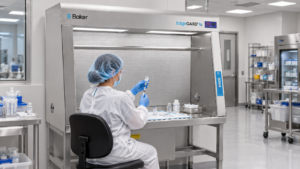
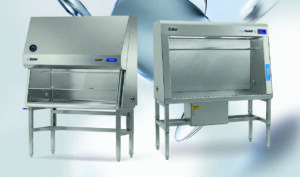
In a clean bench, HEPA-filtered laminar airflow is delivered in either a vertical or horizontal direction across the work area to provide a virtually particulate-free area for conducting procedures and protecting the product from contamination. Biosafety cabinets also provide HEPA-filtered air to the work area for product protection, plus air passes through a HEPA filter before being exhausted from the cabinet for environmental protection.
Components of a HEPA Filter
HEPA filters are made of boron silicate microfibers formed into a flat sheet by a process similar to making paper. Flat filter sheets are pleated to increase the overall surface area. Pleats are separated by aluminum baffles which direct the airflow through the filter. Filter media is very delicate and should never be touched.
How a HEPA Filter Operates
A HEPA filter is designed to target very small particles, and therefore doesn’t work like a typical membrane filter, where particles larger than a given pore size of a filter are captured. Instead, HEPA filters rely on a combination of three mechanisms to trap particles.
The first mechanism is interception, where particles being carried in the airflow around the filter fibers adhere to the filter. Particles must be within one radius of the filter fiber to be captured. Larger particles are often captured by the second mechanism, impaction. Due to their size, these particles cannot adjust to sudden changes in airflow around the filter and essentially run into the filter fiber and become embedded.
The final mechanism is diffusion that occurs because of the way microscopic particles move and interact with surrounding molecules. This is described as Brownian motion, where molecules move in a random, zig-zag pattern because they collide with surrounding molecules. This motion slows down a particle’s path through the HEPA filter and increases the probability that the particle will be captured by either interception or impaction.
HEPA Filter Effectiveness
The ability of a HEPA filter to remove particles depends of the size and velocity of the particles. Due to the mechanisms mentioned above, a HEPA filter does not remove particles only ABOVE a certain size. It can effectively remove particles both above AND below 0.3 microns. In general, large particles (greater than 0.3 microns in diameter) are captured by both the impaction and interception mechanisms, whereas small particles (less than 0.1 micron in diameter) are captured by the diffusion mechanism. Medium particles (from 0.1 to 0.4 microns in diameter) are captured by both the diffusion and interception mechanisms. The most penetrating particle size is 0.3 microns.
HEPA Filter Maintenance
As the cabinet operates, the HEPA filter will collect particulates. The room and cabinet particulate levels along with the capacity of the building exhaust fan determines the life of a HEPA filter. Under most laboratory conditions, you should expect a long filter life. However, misuse or a heavy particulate load within the cabinet will shorten any filter’s life. When the cabinet can no longer maintain proper airflow balance due to the loading of the filters, they will need to be replaced.
If any filter has visible signs of damage or leaks it should be fixed or replaced immediately.
You can find out more information on the lifespan of HEPA filters in biosafety cabinets in our blog post, How Long Does a Biosafety Cabinet Filter Last?
Biosafety Cabinet or Clean Bench?
If you’re not sure which clean air technology is right for you, download our biosafety cabinet decision map and find out.