Understanding Biosafety Cabinet Standards and Requirements

Introduction to Biosafety Cabinets
What is a Biosafety Cabinet?
Biosafety cabinets (BSCs) are essential laboratory equipment used to provide containment while working with biohazardous materials. They are designed to offer three critical types of protection: personnel protection from hazardous agents, product protection to prevent contamination of the research materials, and environmental protection to keep hazardous substances contained within the cabinet. HEPA filtration ensures that all contaminated air is filtered before release.
Why Use a Biosafety Cabinet?
BSCs are vital in settings where work with infectious agents is conducted. They are integral to facilities handling biological agents at Biosafety Levels (BSL) 1 through 4, which range from agents with minimal to severe risk. Through controlled airflow and filtration, BSCs create a safe working environment for laboratory personnel and reduce contamination risk, ensuring the integrity of sensitive experiments.
Types of Biosafety Cabinets: Class I, II, and III
Class I Biosafety Cabinets
Class I cabinets provide personnel and environmental protection by capturing aerosols and contaminants generated inside the cabinet. However, they do not offer product protection as the airflow is not filtered before entering the work area. Class I cabinets are suitable for low-risk applications where product sterility is not a concern.
Class II Biosafety Cabinets
Class II cabinets provide personnel, product, and environmental protection. They are commonly used for applications requiring sterile conditions, such as cell culture and microbiology. They include:
- Type A1 and A2: Type A2 is more widely used as it allows minimal volatile chemical and radionuclides use when externally exhausted through a canopy connection. Both types recirculate a portion of the filtered air inside the cabinet and are suitable for most applications.
- Type B1 and B2: Type B cabinets, in contrast, are hard-ducted cabinets that exhaust 100% of the air from within the BSC, making it suitable for applications involving volatile chemicals and radionuclides adjacent to biohazard work.

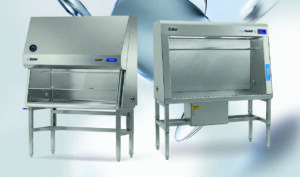
SterilGARD e3 Class II Type A2 BSC
The SterilGARD is a Class II Type A2 Biosafety Cabinet that can be configured for compliance with both NSF 49 and EN 12469.

The BioVanguard is a Class II Microbiological Safety Cabinet from The Baker Company that is for use with EN 12469 (TUV).

BioChemGARD Class II Type B2 BSC
The BioChemGARD is a Class II Type B2 Biosafety Cabinet that can be configured for compliance with both NSF 49 and EN 12469.
Class III Biosafety Cabinets
Class III cabinets are completely enclosed negative pressure gloveboxes, offering maximum containment. All air entering or exiting a Class III cabinet passes through dual inline HEPA filters, making them suitable for BSL 4 agents and highly hazardous materials.
Key Standards for Biosafety Cabinets: NSF/ANSI 49 and EN12469
NSF/ANSI Standard 49
Overview and History
NSF/ANSI standard 49, developed by NSF International in collaboration with the CDC and NIH, was first introduced in 1976 and governs Class II biosafety cabinets. The Baker Company played a critical role in establishing the performance “safe zone” or envelope, an innovation that set a benchmark for airflow control to prevent cross-contamination and ensure user safety.
Certification and Compliance
To meet NSF 49, cabinets undergo rigorous testing, including airflow monitoring, HEPA filtration efficiency, and leak testing. The standard also covers design and construction aspects that ensure durability, cleanability, noise control, and vibration limitations. The certification process is accredited by ANSI and is widely recognized in the U.S.
EN 12469 Standard
Overview and Scope
EN 12469 is the European standard for microbiological safety cabinets, covering a range of containment requirements and performance criteria. Established in 2000 by the European Committee for Standardization (CEN), EN 12469 provides a framework to ensure that biological safety cabinets (BSCs) meet stringent safety requirements. This standard outlines specific criteria for personnel, product, and environmental protection and is widely adopted throughout Europe and other regions, serving as a benchmark for laboratories handling infectious or biohazardous materials.
Key Differences between NSF/ANSI 49 and EN 12469
- Airflow Requirements: NSF/ANSI 49 suggests specific adjustments to airflow tolerances to maintain containment creating a performance envelope of protection, while EN 12469 emphasizes consistent inflow and downflow velocities.
- Testing Protocols: Both standards include HEPA filter testing, but NSF/ANSI 49 requires additional field testing post-installation.
- Geographic Application: NSF/ANSI 49 is prevalent in North America, whereas EN 12469 is standard across the EU. Labs in regions with dual regulatory demands often seek BSCs certified under both standards.
Testing Protocols and Certification Process
Both EN 12469 and NSF/ANSI 49 standards require rigorous testing protocols to certify biological safety cabinets (BSCs), each with stringent guidelines to ensure reliable containment and user protection:
- HEPA Filter Integrity Testing: Tests such as the aerosol photometer method are performed to detect leaks in the filter or around filter seals. These tests are critical for ensuring that contaminants are not returned back to the work area or released into the lab environment.
- Containment Testing: The standards specify containment testing methods for airflow patterns and velocities, ensuring that the cabinet can consistently provide protection during operation.
Downflow and Inflow Velocity Measurements: Velocity measurements for both downflow (air directed toward the work area) and inflow (air entering the cabinet from the laboratory) to ensure containment stability and effective barrier protection.
| NSF/ANSI 49 | EN 12469 | |
|---|---|---|
| Classes | Covers Class II cabinets, subdivided by type. | Covers Classes I-III cabinets; Class II specifications closely align with NSF/ANSI 49. |
| Performance Envelope | Must function within +/-0.025 m/s of inflow and downflow set points based on airspeed parameters. | No specific performance envelope; TUV Nord requires testing of low alarm point. |
| Airflow Smoke Pattern Tests | Required. | Not required. |
| Microbiological Challenge Testing | Includes testing for operator safety, cross-contamination, and product protection. | Adopts NSF/ANSI 49 standards and includes an optional containment validation test in the field (KI-Discus test). |
| Pressurization Testing | Routine soap bubble pressure leak test. | Soap bubble pressure leak test is included as a standard test type. |
| Filter Leak Test | Conducted using a generated aerosol challenge. | Conducted using a generated aerosol challenge. |
| Room Airflow Patterns in Situ | Not required. | Optional, with potassium iodide as the testing method. |
| Airflow Velocity – Downflow | Specifies downflow velocity without detailed requirements; larger number of test points needed; requires thermoanemometer. | Recommended downflow velocity is 0.25-0.50 m/s; does not specify instrument type or accuracy. |
| Airflow Velocity – Inflow | Uses direct inflow measurement (DIM) with a minimum inflow of 100 fpm (0.51 m/s). | Recommends measurement above exhaust and calculates inflow; minimum inflow velocity of 0.4 m/s. |
| Worker Comfort | Noise level: 67 dBA at operator head position; includes vibration testing; light level set at 650 lux. | Noise level: 65 dBA measured 1m from access opening; includes vibration testing; light level set at 650 lux. |
| Other | Evaluates ‘cleanability’ of contaminated surfaces; no noise insulation in contaminated areas; assesses paintwork resistance to chemicals/abrasion; motor/blower testing required. | Includes airflow alarms and audio-visual alerts for malfunction notifications. |